

Looking for the best portable coffee maker for travel? This roundup highlights seven compact, durable options that balance brew quality, speed, and packability.
Choices include quick pod brewing, fast low‑bitterness cups, true high‑pressure espresso without power, rugged insulated immersion for camps, and USB‑C rapid heating with pumped shots.
The comparison covers size, power, materials, and cleanup so readers can pick the best fit.
| Keurig K-Mini Single Serve Coffee Maker (Black) |

| Best For Convenience | Portability: Compact, <5" wide; cord storage for travel | Brewing Method: Single-serve K-Cup drip-style brewer | Power Source: Electric (plug-in countertop) | VIEW LATEST PRICE | Read Our Analysis |
| AeroPress Original XL Portable All-in-One Coffee Maker |

| Best For Capacity | Portability: Lightweight, travel-ready; fits backpack/carry-on | Brewing Method: Air-pressure micro-filter (AeroPress 3‑in‑1) | Power Source: Manual (no power required) | VIEW LATEST PRICE | Read Our Analysis |
| AeroPress Original Manual Coffee Press Brewer |

| Best For Versatility | Portability: Compact and lightweight for travel/camping | Brewing Method: Air-pressure micro-filter (AeroPress 3‑in‑1) | Power Source: Manual (no power required) | VIEW LATEST PRICE | Read Our Analysis |
| AeroPress Go Portable Travel Coffee Maker Kit |

| Best For Travel | Portability: Designed for travel; brewer packs into mug | Brewing Method: Air-pressure micro-filter (AeroPress 3‑in‑1 travel) | Power Source: Manual (no power required) | VIEW LATEST PRICE | Read Our Analysis |
| STANLEY 32oz Insulated Stainless Steel French Press |

| Best For Durability | Portability: Compact, foldable handle for backpacking/camping | Brewing Method: French press (plunger mesh filter) | Power Source: Stovetop/campfire or no power (manual) | VIEW LATEST PRICE | Read Our Analysis |
| WACACO Nanopresso Portable Manual Espresso Machine (Grey) |

| Best For Espresso | Portability: Small, lightweight (340 g) portable unit | Brewing Method: Manual high-pressure espresso-style pump (Nanopresso) | Power Source: Manual hand-pump (no electricity) | VIEW LATEST PRICE | Read Our Analysis |
| OutIn Nano Portable USB-C Electric Espresso Maker |
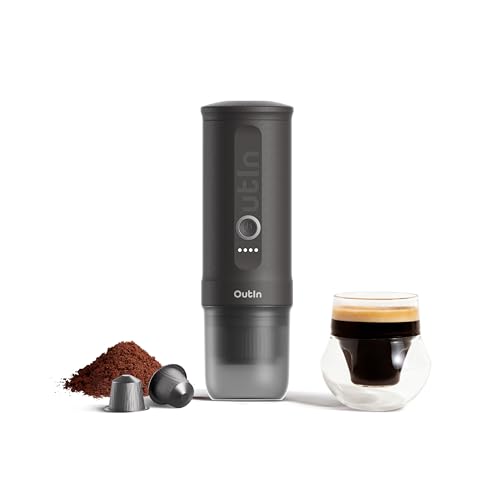
| Best For On-the-Go Power | Portability: Portable travel/camping/Car/RV use (670 g) | Brewing Method: Electric espresso extraction (20-bar) accepts grounds or NS capsules | Power Source: Rechargeable battery (USB-C) | VIEW LATEST PRICE | Read Our Analysis |
More Details on Our Top Picks
Keurig K-Mini Single Serve Coffee Maker (Black)
If you need a compact brewer that fits tight spaces and travels well, I’d pick the Keurig K‑Mini—at under 5 inches wide it tucks into backpacks, dorm rooms, or hotel countertops without fuss. I like its matte finish and variety of colors, plus cord storage keeps counters tidy. It brews 6–12 oz using K‑Cup pods or My K‑Cup with your grounds, and the one-cup reservoir means fresh water each brew. A removable drip tray fits travel mugs up to 7 inches and catches spills. Coffee’s ready fast, and auto-off after 90 seconds saves energy. It includes the K‑Mini unit.
- Portability:Compact, <5" wide; cord storage for travel
- Brewing Method:Single-serve K-Cup drip-style brewer
- Power Source:Electric (plug-in countertop)
- Brew Speed:Brews in minutes (single-cup minutes)
- Capacity (Typical Output):Single cup, 6–12 oz per brew; one-cup reservoir
- Ease of Cleaning:Simple drip tray removable; basic cleanup
- Additional Feature:Cord storage compartment
- Additional Feature:Removable drip tray
- Additional Feature:Auto-off after 90s
AeroPress Original XL Portable All-in-One Coffee Maker
I recommend the AeroPress Original XL for travelers who want café-quality coffee fast without bulky gear: I can brew a generous 20 oz (600 ml) pot or a concentrated espresso-style shot using its patented 3-in-1 air‑pressure and micro‑filter system, all in about two minutes, then pop out the spent grounds and rinse for effortless cleanup. I appreciate the extra-large Tritan carafe’s durability and compactness—fits a backpack or carry-on. The air-pressure extraction cuts bitterness and grit while preserving tasting notes. I control brew time, temperature, and grind to make drip, cold brew, iced coffee, or espresso-style drinks on the road.
- Portability:Lightweight, travel-ready; fits backpack/carry-on
- Brewing Method:Air-pressure micro-filter (AeroPress 3‑in‑1)
- Power Source:Manual (no power required)
- Brew Speed:~2 minutes total brew time
- Capacity (Typical Output):Up to 20 oz (600 ml) — single large cup or two small cups
- Ease of Cleaning:Pop out grinds, rinse — very easy
- Additional Feature:Crystal Tritan carafe
- Additional Feature:Double standard size
- Additional Feature:Micro-filtration system
AeroPress Original Manual Coffee Press Brewer
You’ll find the AeroPress Original ideal when you want a single, fast, travel-ready cup that still lets you control brew time and grind for a rich, clean flavor. I use it because its patented 3-in-1 design blends French press, pour-over, and espresso techniques into one compact, shatterproof unit that fits a backpack or carry-on. Air pressure plus micro-filtration gives a full-bodied, low-bitterness cup in under two minutes. I can tweak water temperature, grind size, and brew time for hot, cold, or espresso-style drinks. Cleanup’s seconds—pop out the puck and rinse—so it’s perfect for travel.
- Portability:Compact and lightweight for travel/camping
- Brewing Method:Air-pressure micro-filter (AeroPress 3‑in‑1)
- Power Source:Manual (no power required)
- Brew Speed:Under 2 minutes per brew
- Capacity (Typical Output):Single-cup (standard AeroPress size)
- Ease of Cleaning:Pop out grinds, rinse — very easy
- Additional Feature:Compact travel-friendly design
- Additional Feature:Quick 2-minute brew
- Additional Feature:Pop-out puck disposal
AeroPress Go Portable Travel Coffee Maker Kit
For travelers who want café-quality coffee without hauling bulky gear, I recommend the AeroPress Go: a compact, all-in-one brewer that packs into its mug and brews a smooth cup in under two minutes. I like that the mug doubles as storage and is microwaveable with a silicone lid—great for camping, hiking, or boating. Its patented 3-in-1 design uses air pressure and micro-filtration to cut bitterness and grit while preserving flavor. I can tweak grind size, brew time, and temperature for hot or iced drinks, and cleanup is fast—grounds pop out and a quick rinse readies it for the next trip.
- Portability:Designed for travel; brewer packs into mug
- Brewing Method:Air-pressure micro-filter (AeroPress 3‑in‑1 travel)
- Power Source:Manual (no power required)
- Brew Speed:Under 2 minutes per brew
- Capacity (Typical Output):Single-cup travel size (fits in provided mug)
- Ease of Cleaning:Pop out grinds, rinse — very easy
- Additional Feature:Mug doubles as storage
- Additional Feature:Microwaveable travel mug
- Additional Feature:Brewer nests into mug
STANLEY 32oz Insulated Stainless Steel French Press
If I had to pick one travel-friendly brewer for rough-and-tumble trips, I’d point to the STANLEY 32oz Insulated Stainless Steel French Press. I rely on its 18/8 stainless body — nearly indestructible — to boil water, brew coffee, or even heat soup over a stove or campfire. The insulated walls keep drinks hot up to four hours, and the mesh plunger traps grounds cleanly after a five-minute brew. It packs well: foldable handle and interior room for a small coffee container. Note grind size and dose affect extraction and espresso-like yields, so adjust tamping and dose when switching grinds.
- Portability:Compact, foldable handle for backpacking/camping
- Brewing Method:French press (plunger mesh filter)
- Power Source:Stovetop/campfire or no power (manual)
- Brew Speed:~5-minute brew time
- Capacity (Typical Output):32 oz (full French press capacity)
- Ease of Cleaning:Mesh filter/plunger; requires rinsing and cleaning
- Additional Feature:18/8 stainless steel
- Additional Feature:Boil/cook over fire
- Additional Feature:Foldable space-saving handle
WACACO Nanopresso Portable Manual Espresso Machine (Grey)
I recommend the WACACO Nanopresso for travelers who want true espresso on the go: its manual pump delivers up to 18 bar of pressure without batteries or electricity, so I can pull a rich shot from its 80 ml water reservoir and 7 g coffee basket anywhere. I appreciate its lightweight 340 g build and compact 156 x 71 x 62 mm size—easy to slip into a bag. Made from PBT, PP, and stainless steel, it’s 100% BPA-free and simple to clean. The kit includes a cup, filter basket, scoop, brush, pouch, and instruction book for hassle-free use.
- Portability:Small, lightweight (340 g) portable unit
- Brewing Method:Manual high-pressure espresso-style pump (Nanopresso)
- Power Source:Manual hand-pump (no electricity)
- Brew Speed:Immediate manual extraction (single-shot pressure)
- Capacity (Typical Output):80 ml water capacity; ~1 espresso shot (7 g coffee)
- Ease of Cleaning:Easy to clean; disassemble and rinse
- Additional Feature:Up to 18-bar pressure
- Additional Feature:Includes carrying pouch
- Additional Feature:Lightweight 340 g
OutIn Nano Portable USB-C Electric Espresso Maker
You’ll appreciate the OutIn Nano if you want true espresso on the go—its 20-bar pump and rapid USB-C heating give thick crema from either ground coffee or Nespresso-style capsules. I take it camping, in the car, and to the office; at 670 g it’s sturdy yet portable, built from food-grade stainless steel and sustainable materials. It heats 1.7 oz to 198°F in about 200 seconds and delivers a shot in 3–4 minutes. Three 2500 mAh batteries give roughly five shots per charge (or 200+ with preheated water). It’s leak-proof, easy to clean, and covered by 12-month support. Carry-on only.
- Portability:Portable travel/camping/Car/RV use (670 g)
- Brewing Method:Electric espresso extraction (20-bar) accepts grounds or NS capsules
- Power Source:Rechargeable battery (USB-C)
- Brew Speed:3–4 minutes to espresso shot (heating + brew)
- Capacity (Typical Output):Heats 1.7 oz per shot; multiple shots per charge (up to 5 hot shots)
- Ease of Cleaning:Easy to disassemble and wash (dish-safe parts)
- Additional Feature:Accepts NS capsules
- Additional Feature:USB-C rechargeable battery
- Additional Feature:20-bar electric pump
Factors to Consider When Choosing a Portable Coffee Maker for Travel
When selecting a portable coffee maker for travel, practical factors such as size and weight determine carry convenience while brewing capacity affects how many servings it produces. Power source options and the degree of brew quality control influence where and how consistently good coffee can be made. Durability and materials define longevity and suitability for varied travel conditions.
Size And Weight
For travelers, size and weight are the most immediate constraints when choosing a portable coffee maker: aim for devices under 1 kg (2.2 lb) for true packability, check collapsed dimensions (roughly 25 cm long and 7–8 cm in diameter fit most backpacks and carry-on pouches), and prefer models that stow accessories internally to avoid extra bulk. Compactness reduces hassle; integrated storage for filters, scoops and cups prevents loose parts. Assess material trade-offs—lightweight plastics lower pack weight but can sacrifice impact resistance compared with stainless steel. Always include filled weight in evaluations: water or beans add several hundred grams and can make a marginally light unit cumbersome. Practical choices balance minimal dimensions, accessory storage and sufficient durability for travel conditions.
Brewing Capacity
Brewing capacity dictates how many drinks a traveler can produce between refills and how concentrated those drinks will be: single-cup brewers (6–12 oz) suit solo travelers, larger or multi-cup units (up to ~20 oz) work for pairs or sharing, and espresso-style devices yield small 1–2 oz shots that may require multiple extractions to make milk-based drinks without dilution. Travelers should consider maximum brew volume per cycle and whether water must be added each time; small reservoirs force frequent top-ups. For espresso-style units, assess whether multiple extractions are practical for lattes or cappuccinos and whether the device produces sufficiently concentrated shots. Account for reheating or preheating limits, since small heaters may need repeated cycles for several cups, increasing total brew time.
Power Source Options
Power-source choice is a core travel consideration because it determines where and how consistently coffee can be brewed on the road. Battery-powered models use internal rechargeable cells (commonly 2000–7500 mAh), deliver multiple brews per charge, and recharge via USB or car adapter, but add weight and require recharging. Manual brewers rely on user force or gravity/pressure, need no electricity, and are the lightest, most reliable option for remote travel. Stove- or campfire-compatible devices use an external heat source, can double as cookware, require fuel and safe gear, and take minutes to reach brewing temperature. Thermally insulated or vacuum-flask designs preserve heat for hours and, when preheated with hot water, remove dependence on onboard heating. Rapid electric heaters reach brewing temps in 2–4 minutes but reduce total brews per charge.
Brew Quality Control
After selecting a suitable power option, attention shifts to how that device influences the final cup: grind size, water temperature, contact time, dose, and filtration together dictate extraction and flavor. Grind size must match the brew method—fine for pressure-based shots, coarser for immersion or pour-over—to control extraction and bitterness. Water temperature near 195–205°F (90–96°C) guarantees balanced extraction; cooler water under-extracts acidity, hotter water yields bitterness. Brew time and contact control vary by method: roughly 30 seconds for pressure, 2–5 minutes for immersion, much longer for cold brew, affecting strength and body. Maintain consistent coffee-to-water ratios (1:15–1:18 drip/immersion; 1:2–1:3 espresso) for predictable results. Finally, choose filtration thoughtfully: finer filters cut sediment and perceived bitterness, coarser filters preserve oils and body.
Durability And Materials
When evaluating portable coffee makers for travel, attention to materials and construction determines whether a device survives frequent handling and temperature changes. Travelers should favor 18/8 stainless steel or reinforced polycarbonate exteriors for resistance to dents, corrosion, and heat; thin metals and cheap plastics fail sooner. Seals, gaskets, and moving parts made from BPA‑free silicone or sturdy thermoplastics are critical for leak resistance and durability under repeated pressure and thermal cycling. Shatterproof components such as Tritan protect against drops during car, backpack, or campsite use. Balance weight and strength: lighter alloys and engineered plastics reduce carry burden but must have sufficient thickness and build quality to avoid flexing or cracking. Corrosion‑resistant finishes, secure fastenings, and replaceable wear parts extend a unit’s service life.
Cleanup And Maintenance
Durability and materials affect not only how a portable coffee maker survives travel but also how easy it is to keep clean; rugged construction with simple fastenings often means fewer crevices where grounds and oils can hide. Models with few parts and tool‑free disassembly that come apart in under 30 seconds enable quick rinsing or popping out spent grounds. Stainless steel or BPA‑free Tritan plastics resist staining and odor retention, reducing scrubbing and lingering coffee smells. Micro‑filter systems or sealed puck ejectors contain and dispose of grounds neatly, minimizing mess. Consider whether the brewer’s water capacity requires per‑cup refills, increasing rinse frequency. Prefer methods with minimal consumables and no exposed electrical components so users can perform fast, safe cleaning on the road.
Travel Compatibility
For travel, compatibility means more than portability: it encompasses size and weight limits, power options, airline and security restrictions, and the practicalities of packing and using the brewer on the move. Travelers should choose compact, lightweight units—often under 1 kg/2.2 lb—that fit in backpacks or carry-ons. Power-source flexibility matters: battery-, USB-C–powered, or manual makers eliminate the need for local voltage adapters, while mains-only devices may complicate international trips. Devices must be airline- and security-friendly: removable reservoirs, emptied liquids and grounds, and adherence to carry-on liquid rules simplify screening. Rugged, spill-proof construction with leak seals and secure storage reduces damage risk. Finally, evaluate on-the-go workflow: water and grounds per brew, cleaning without running water, and compatibility with common travel cups.