

Travel trailers need reliable power for comfort and safety on the road.
Compact inverters like the Jackery Explorer 300 offer quiet, portable backup for small electronics.
Dual-fuel giants from Westinghouse (5000W and 6500W) deliver strong starting watts and long run times for heavy loads.
Inverter generators such as the WEN 5600W and Westinghouse 4000W provide quiet, clean power with parallel expandability and useful outlet options.
| Jackery Explorer 300 Portable Power Station (293Wh) |

| Compact & Portable | Power Type / Fuel: Battery (portable power station; rechargeable lithium-ion) | Output Power (rated/usable): 293Wh battery; 300W continuous AC | Outlets / Ports: AC outlets (2 pure sine wave), USB-C PD 60W, QC3.0 USB-A, USB-A, DC car port | VIEW LATEST PRICE | Read Our Analysis |
| Westinghouse 5000W Dual Fuel Portable Inverter Generator |

| High-Power Dual Fuel | Power Type / Fuel: Dual fuel (gasoline or propane) | Output Power (rated/usable): 3900W running; 5000W peak | Outlets / Ports: TT-30R 30A RV outlet, two 120V 20A household outlets (duplex), two USB outlets | VIEW LATEST PRICE | Read Our Analysis |
| WEN 5600W Portable Electric-Start Generator (GN5602X) |

| Heavy-Duty Workhorse | Power Type / Fuel: Gasoline (engine-driven) | Output Power (rated/usable): 4500W running; 5600W starting | Outlets / Ports: Two 120V 20A outlets, one TT-30R 30A RV outlet, one L5-30R 30A twist-lock | VIEW LATEST PRICE | Read Our Analysis |
| Westinghouse 6500W Dual Fuel Portable Backup Generator |
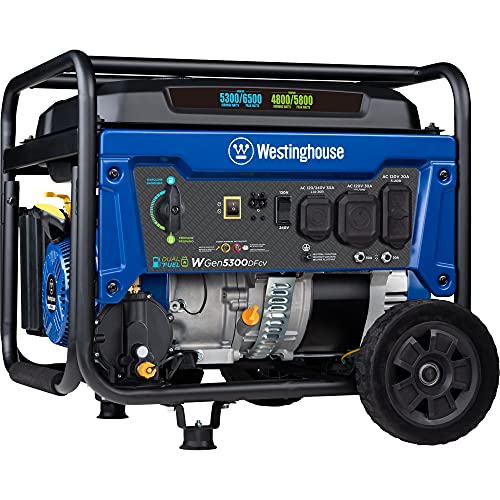
| Whole-House Backup | Power Type / Fuel: Dual fuel (gasoline or propane) | Output Power (rated/usable): 5300W running (gasoline); 4800W running (propane); 6500W peak (gasoline) | Outlets / Ports: One 120V 20A duplex, one TT-30R 30A, one L14-30R 30A transfer-switch-ready | VIEW LATEST PRICE | Read Our Analysis |
| Westinghouse 4000W Dual Fuel Quiet Portable Inverter Generator |

| Quiet RV-Friendly | Power Type / Fuel: Dual fuel (gasoline or propane) | Output Power (rated/usable): 3300W rated; 4000W peak | Outlets / Ports: One 120V 20A duplex, one TT-30R 30A, two USB outlets | VIEW LATEST PRICE | Read Our Analysis |
More Details on Our Top Picks
Jackery Explorer 300 Portable Power Station (293Wh)
The Jackery Explorer 300 (293Wh) is best suited for lightweight travelers and weekend campers who need a compact, fast-recharging power solution. It houses a 293Wh lithium-ion pack with two pure sine-wave AC outlets delivering 300W continuous power, capable of running multiple devices simultaneously. Recharging reaches 80% in two hours when using an AC outlet and the 60W PD USB-C together; it also accepts car charging and solar input, with an integrated MPPT controller to optimize panel performance. Ports include 60W PD (in/out), Quick Charge 3.0, a standard USB-A, and a DC car port. Weighing 7.1 pounds, it ships with adapter and car cable; SolarSaga panels sold separately.
- Power Type / Fuel:Battery (portable power station; rechargeable lithium-ion)
- Output Power (rated/usable):293Wh battery; 300W continuous AC
- Outlets / Ports:AC outlets (2 pure sine wave), USB-C PD 60W, QC3.0 USB-A, USB-A, DC car port
- Portability / Weight & Handling:Lightweight portable — 7.1 pounds
- Safety / Shutdown Features:Pure sine wave output (safe for electronics); integrated MPPT for optimized charging
- Warranty / Support:(Manufacturer support details not specified in summary; includes user guide) — (no explicit warranty listed)
- Additional Feature:Fast dual-input recharge
- Additional Feature:USB-C PD 60W
- Additional Feature:Weighs 7.1 pounds
Westinghouse 5000W Dual Fuel Portable Inverter Generator
Offering a blend of quiet operation and flexible fueling, the Westinghouse iGen5000DF is ideal for travel trailer owners who need near-silent, inverter-quality power with the option to run on gasoline or propane. This blue/black unit delivers 5000 peak and 3900 running watts with <3% THD, a 120V/30A TT-30R RV outlet, two 20A household outlets, two USB ports, and parallel capability. A 4-stroke engine, 3.4-gallon tank and economy mode yield up to 18 hours runtime. Start options include remote key fob, push-button electric or recoil. At 104.7 lb it features wheels, telescoping handle, LED data center and a three-year warranty.
- Power Type / Fuel:Dual fuel (gasoline or propane)
- Output Power (rated/usable):3900W running; 5000W peak
- Outlets / Ports:TT-30R 30A RV outlet, two 120V 20A household outlets (duplex), two USB outlets
- Portability / Weight & Handling:Portable with wheels and telescoping handle — 104.7 pounds
- Safety / Shutdown Features:<3% THD (safe for sensitive electronics); EPA compliant
- Warranty / Support:3-year limited warranty; nationwide service network; lifetime technical support
- Additional Feature:Dual-fuel capability
- Additional Feature:Remote key-fob start
- Additional Feature:LED data center
WEN 5600W Portable Electric-Start Generator (GN5602X)
Ideal for RV owners who need reliable mid-range power without heavy-duty cost, the WEN 5600W GN5602X pairs a 224cc engine and electric start with 5600 starting/4500 running watts to handle air conditioners, appliances, and charging needs. A 4.3-gallon tank delivers up to 12.5 hours at half load, balancing runtime and portability. Safety features include the WEN Watchdog CO Shutdown Sensor that stops operation if carbon monoxide reaches dangerous levels. Outlet configuration suits travel trailers: two 120V 5-20R outlets, one RV-ready 120V 30A TT-30R, and a transfer-switch-ready 120V 30A L5-30R twist-lock. A wheel kit and three-year limited warranty complete the package.
- Power Type / Fuel:Gasoline (engine-driven)
- Output Power (rated/usable):4500W running; 5600W starting
- Outlets / Ports:Two 120V 20A outlets, one TT-30R 30A RV outlet, one L5-30R 30A twist-lock
- Portability / Weight & Handling:Portable with wheel kit — (item weight not listed; includes wheels)
- Safety / Shutdown Features:WEN Watchdog CO Shutdown Sensor (automatic CO shutoff)
- Warranty / Support:Three-year limited warranty
- Additional Feature:CO auto-shutdown (Watchdog)
- Additional Feature:Transfer-switch ready outlet
- Additional Feature:Wheel kit included
Westinghouse 6500W Dual Fuel Portable Backup Generator
Westinghouse’s 6500W Dual Fuel portable backup generator suits travel-trailer owners who need reliable, multi-fuel power with RV-ready connections, delivering up to 5300 running watts on gasoline and a propane option for extended use. The unit produces 6500 peak watts (gasoline) and 5800 peak watts (propane), with a 4.7-gallon tank and up to 14.5 hours run time. A 274 cc OHV engine with cast-iron sleeve provides durability, plus automatic low-oil and CO shutdowns and EPA compliance. Outlets include a 120V duplex, RV-ready TT-30R and transfer-switch-ready L14-30R. Includes propane hose, oil, wheel kit, tool kit, and a three-year limited warranty.
- Power Type / Fuel:Dual fuel (gasoline or propane)
- Output Power (rated/usable):5300W running (gasoline); 4800W running (propane); 6500W peak (gasoline)
- Outlets / Ports:One 120V 20A duplex, one TT-30R 30A, one L14-30R 30A transfer-switch-ready
- Portability / Weight & Handling:Portable with wheel kit and minimal assembly required — (weight not listed)
- Safety / Shutdown Features:Automatic low-oil shutdown; CO shutdown; EPA compliant
- Warranty / Support:3-year limited coverage; nationwide customer service network
- Additional Feature:120/240V volt selector
- Additional Feature:Cast-iron cylinder sleeve
- Additional Feature:Propane-ready runtime specs
Westinghouse 4000W Dual Fuel Quiet Portable Inverter Generator
With a dual-fuel design and 3,300 rated watts of clean inverter power, the Westinghouse 4000W dual-fuel generator suits travel-trailer owners who need reliable, RV-ready power plus the flexibility to run on gasoline or propane. It delivers 4,000 peak watts, <3% THD, and parallel capability for added capacity. Dual-fuel operation, a 1.69-gallon tank, economy mode and up to seven hours runtime on gasoline balance efficiency and endurance. Quiet at 52 dBA, it offers electric/recoil start, remote key-fob start, telescoping handle and a rotating digital display for fuel, output and runtime. RV TT-30R, household outlets, USB, CO shutdown and three-year coverage complete the package.
- Power Type / Fuel:Dual fuel (gasoline or propane)
- Output Power (rated/usable):3300W rated; 4000W peak
- Outlets / Ports:One 120V 20A duplex, one TT-30R 30A, two USB outlets
- Portability / Weight & Handling:Portable with telescoping handle — (weight not listed)
- Safety / Shutdown Features:Automatic low-oil shutdown; CO shutdown and CO sensor; <3% THD
- Warranty / Support:3-year limited coverage; nationwide customer service network
- Additional Feature:<3% THD output
- Additional Feature:Parallel capable design
- Additional Feature:CO sensor included
Factors to Consider When Choosing Generators For Travel Trailers
Before you pick a generator for your travel trailer, I’ll walk through the key factors that actually matter: power output needs, fuel type preference, noise level, portability and weight, and outlet/plug types. I’ll explain how each affects what you can run, how long it’ll run, and how easy it is to move and hook up. By the end you’ll know which trade-offs matter most for your trips.
Power Output Needs
Start by tallying what you’ll actually run at once so you don’t underestimate your needs: I add up each appliance’s continuous draw—AC, fridge, microwave, lights, water heater, chargers—because running wattage, not just startup, determines the generator size you’ll need. Then I factor in motor surge: ACs and fridges can need 2–3× running watts at startup, so I choose a unit whose peak/starting capacity covers those surges. I check THD and aim for <3% when I plan to power laptops, inverters, or sensitive RV electronics. I also compare rated running watts, fuel capacity, and economy-mode runtime to avoid overloading during long trips. Finally, I verify outlet types and continuous-current ratings match my trailer’s shore-power requirements.
Fuel Type Preference
Now that I’ve covered matching generator output to trailer loads, I look at fuel type because it directly shapes runtime, maintenance, and practicality on the road. I prefer gasoline if I expect heavy loads or long runtimes—its higher power density and widespread availability make it convenient, though I store it safely and use stabilizers for seasonal layups. Propane appeals when I want cleaner burning, fewer carbon deposits, and simple long-term storage; it reduces maintenance but requires planning for refills. Dual-fuel units give me flexibility to switch when one fuel’s scarce and can extend runtime. Finally, I match fuel to route and climate: gasoline is everywhere, propane can struggle in extreme cold due to vapor pressure, and trip duration dictates whether storage or refills matter most.
Noise Level Considerations
How loud do you want your campsite to be? I aim for generators at or below about 52 dBA when I plan to camp near others or run power at night—each 10 dBA sounds roughly twice as loud. I prefer inverter models or units with economy/variable-speed modes because they cut RPM under light loads and run much quieter than fixed-speed designs. When comparing specs, I check whether noise was measured at the same distance (commonly 7 meters/23 feet) so figures are comparable. I also plan for higher noise during startup, acceleration, or heavy loads and verify peak and no-load ratings. Finally, I use vibration-damping pads, acoustical enclosures, and place the generator downwind and as far from the trailer as practical to reduce perceived noise.
Portability And Weight
Think about how you’ll actually move and store the unit: I check a generator’s weight and mobility features (wheels, telescoping handle) to make sure I can lift or roll it from the vehicle without help, and I measure its footprint to confirm it fits my storage compartment or hitch carrier. I prioritize compact dimensions so it won’t block access or exceed space limits. I consider weight distribution and center of gravity—taller, top‑heavy units can tip or be unstable on uneven ground. For roof, bed, or tongue mounting I verify the generator’s weight against load ratings to avoid overloading and affecting towing stability. Finally, I balance power needs against portability, picking the lightest model that still reliably runs my essential appliances.
Outlet And Plug Types
Why does outlet selection matter? I always check outlets first because the wrong plug leaves gear unusable. If your trailer uses a 30‑amp inlet, confirm the generator has a TT‑30R 120V/30A outlet for air conditioners and heavy loads. For 50‑amp service, make sure it provides an L14‑30/L14‑50 or a transfer‑switch‑ready 120/240V outlet with the correct twist‑lock plug to feed both legs. I also value standard 5–20R household outlets and USB ports for small devices without adapters. Verify each outlet’s available amperage and whether it’s GFCI or weather‑protected to meet loads and campsite rules. Finally, if you plan to parallel units or run an inverter, pick generators that are parallel‑ready and use compatible plugs and wiring.
Runtime And Fuel Capacity
Now that you’ve checked outlets and plugs, I look next at runtime and fuel capacity because they determine how long your trailer’s systems will stay powered between refuels. I estimate required runtime by tallying daily hours for critical loads—AC, fridge, lights—so the tank meets that duration without surprises. I compare manufacturers’ tank sizes and stated runtimes at specified loads (like hours at 50% load) to gauge realistic between-fill-ups performance. If I can, I favor dual‑fuel or alternative‑fuel units and check fuel availability on my route since propane and gasoline differ in energy density and storage life. I use economy/variable‑speed modes and load management to stretch runtime, and I plan reserves—extra cans or long‑run tanks—and refueling stops.
Safety And CO Protection
Because carbon monoxide is invisible and deadly, I make CO safety my top priority when choosing a generator for a travel trailer. I look for models with automatic CO shutdown or built-in CO sensors that stop the engine if levels climb. I always position the generator at least 20 feet downwind of the trailer and away from doors, windows, vents, and open hatches to keep exhaust out of living spaces. I never run a generator inside the trailer, under an awning, or in any enclosed or partially enclosed area. I guarantee working battery-operated or hardwired CO detectors are installed and tested before each trip. Finally, I follow manufacturer maintenance—fuel, oil, and exhaust checks—and never modify exhaust or ventilation paths.
Parallel And Expandability
Keeping CO risks low is part of safe generator use, but when campsite power needs grow I look at parallel capability to expand output without buying a much larger unit. I make sure the model is explicitly parallel-capable and that the manufacturer specifies combined starting and running watts so I know what loads I can handle. I check the parallel kit or cable rating for the required amperage and confirm both units share the same voltage and frequency (e.g., 120V, 60Hz) to avoid phase or load imbalance. I also verify synchronized start/stop and low harmonic distortion (<3% THD) to safely run sensitive electronics. Finally, I weigh transport and installation impacts—extra weight, footprint, and whether a transfer switch or wired connections are needed.