Portable boat chargers keep batteries ready for safe starts and reliable onboard power.
I chose units based on durability, recovery performance, and how convenient they are to carry and use.
For compact emergency starts I recommend the NOCO Boost GB40 (1000A, IP65, ~20 starts) and the faster‑recharging Boost X GBX45 (1250A, 60W power bank).
For ongoing battery care the Genius1 (1A), GENIUS5 (5A) and Genius10 (10A) handle maintenance, desulfation and low‑voltage recovery for 6V and 12V banks.
| NOCO Boost GB40 1000A Portable 12V Jump Starter |

| Best Compact Emergency | Voltage Support: 12V | Jump/Start Capability: Jump starter (1000A, up to 20 starts) | Battery Chemistry Compatibility: Lithium (high-discharge lithium) | VIEW LATEST PRICE | Read Our Analysis |
| NOCO Genius1 1A Smart 6V/12V Battery Charger |

| Best Small Maintainer | Voltage Support: 6V / 12V | Jump/Start Capability: Charger/maintainer (no jump start) | Battery Chemistry Compatibility: Lead-acid (AGM/Gel/SLA/VRLA) and LiFePO4 | VIEW LATEST PRICE | Read Our Analysis |
| NOCO GENIUS5 5A Smart 6V/12V Battery Charger |

| Best All-Purpose Charger | Voltage Support: 6V / 12V | Jump/Start Capability: Charger/maintainer (no jump start) | Battery Chemistry Compatibility: Lead-acid (AGM/Gel/SLA/VRLA) and LiFePO4 | VIEW LATEST PRICE | Read Our Analysis |
| NOCO Genius10 10A 6V/12V Smart Battery Charger |

| Best Fast Maintainer | Voltage Support: 6V / 12V | Jump/Start Capability: Charger/maintainer (no jump start) | Battery Chemistry Compatibility: Lead-acid (AGM/Gel/SLA/VRLA) and LiFePO4 | VIEW LATEST PRICE | Read Our Analysis |
| NOCO Boost X GBX45 1250A 12V Jump Starter |
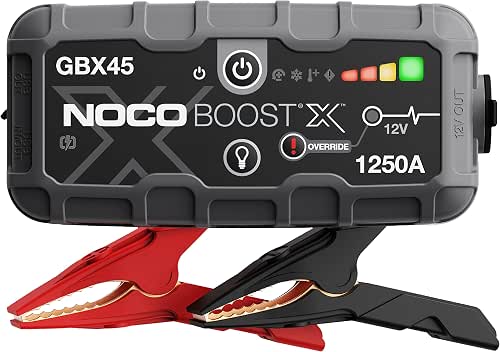
| Best High-Power Portable | Voltage Support: 12V | Jump/Start Capability: Jump starter (1250A, up to 6 starts) | Battery Chemistry Compatibility: Lithium (high-discharge lithium) | VIEW LATEST PRICE | Read Our Analysis |
More Details on Our Top Picks
NOCO Boost GB40 1000A Portable 12V Jump Starter
Targeting boaters who need a compact, high-output emergency starter, the NOCO Boost GB40 delivers 1000 amps of peak lithium power—enough to start most small to mid-size marine engines rapidly—while providing up to 20 starts per charge and integrated USB-C power for mobile devices. Its high-discharge lithium pack supports up to 6.0L gas and 3.0L diesel engines, recharges in three hours, and weighs 2.5 lb for easy storage. Safety features include spark-proof operation, reverse polarity protection, and high-conductivity clamps. A 100-lumen LED with SOS/strobe, IP65 rugged housing, cables, storage bag, and one-year warranty complete the package.
- Voltage Support:12V
- Jump/Start Capability:Jump starter (1000A, up to 20 starts)
- Battery Chemistry Compatibility:Lithium (high-discharge lithium)
- Portable Lighting:100-lumen LED flashlight, 7 modes (SOS/strobe)
- Safety Protections:Spark-proof, reverse polarity protection, high-conductivity clamps
- Warranty:1-year warranty
- Additional Feature:Integrated power bank
- Additional Feature:3-hour recharge time
- Additional Feature:IP65 rugged housing
NOCO Genius1 1A Smart 6V/12V Battery Charger
Boaters seeking a compact, multi-chemistry solution will find the NOCO Genius1 ideal for maintaining small batteries onboard. The 1A 6V/12V smart charger is 35% smaller than its predecessor yet delivers over 35% more power, functioning as charger, maintainer, trickle charger and desulfator. It supports lead‑acid (AGM, Gel, SLA, VRLA) and LiFePO4 batteries across marine, powersport and automotive applications. An integrated thermal sensor adjusts charging to ambient conditions; precision pulse charging reverses sulfation. It accepts deeply discharged batteries (down to 0–1V with Force Mode) and permits indefinite maintenance. Includes wall plug, 110‑inch DC cable with clamps/eyelets, and a 3‑year warranty.
- Voltage Support:6V / 12V
- Jump/Start Capability:Charger/maintainer (no jump start)
- Battery Chemistry Compatibility:Lead-acid (AGM/Gel/SLA/VRLA) and LiFePO4
- Portable Lighting:(No dedicated flashlight listed)
- Safety Protections:Overcharge protection, precision charging, safe indefinite connection
- Warranty:3-year warranty
- Additional Feature:35% smaller footprint
- Additional Feature:Charges from 1V
- Additional Feature:Thermal sensor compensation
NOCO GENIUS5 5A Smart 6V/12V Battery Charger
Ideal for boat owners who need dependable, compact charging for a range of battery types, the NOCO GENIUS5 delivers 5 amps of smart charging for 6V and 12V batteries in a unit 34% smaller than its predecessor while providing over 65% more power. The GENIUS5 supports lead‑acid (AGM, Gel, SLA, VRLA) and LiFePO4 chemistries across flooded, deep‑cycle, marine, and powersport batteries. Features include multi‑mode charging, maintainer/trickle/desulfation functions, Force Mode to start at 0–1V, precision pulse recovery, and temperature compensation. Includes long AC/DC cables, clamps, eyelets, mounting kit, and a three‑year warranty—suitable for boats, RVs, ATVs, and more.
- Voltage Support:6V / 12V
- Jump/Start Capability:Charger/maintainer (no jump start)
- Battery Chemistry Compatibility:Lead-acid (AGM/Gel/SLA/VRLA) and LiFePO4
- Portable Lighting:(No dedicated flashlight listed)
- Safety Protections:Overcharge protection, automatic maintainer, recovery features
- Warranty:3-year warranty
- Additional Feature:Includes mounting bracket
- Additional Feature:5A higher-power output
- Additional Feature:Restores sulfated batteries
NOCO Genius10 10A 6V/12V Smart Battery Charger
For owners of small to mid-size boats who need a compact, high-output charger, the NOCO Genius10 delivers 10 amps for 6V/12V batteries while packing 115% more power than the previous G7200 model in a unit that’s 17% smaller. The Genius10 supports lead-acid (AGM, Gel, SLA, VRLA) and LiFePO4 chemistries, servicing marine, powersport, automotive, and utility batteries. It functions as charger, maintainer, trickle charger, and desulfator, reviving sulfated cells and charging from 1V or using Force Mode to revive 0V batteries. Thermal sensing, temperature compensation, and overcharge protection permit indefinite, safe maintenance. Includes cables, mounting hardware, and a three-year warranty.
- Voltage Support:6V / 12V
- Jump/Start Capability:Charger/maintainer (no jump start)
- Battery Chemistry Compatibility:Lead-acid (AGM/Gel/SLA/VRLA) and LiFePO4
- Portable Lighting:(No dedicated flashlight listed)
- Safety Protections:Overcharge protection, temperature compensation, safe indefinite connection
- Warranty:3-year warranty
- Additional Feature:10A fast charging
- Additional Feature:Temperature compensation built-in
- Additional Feature:Includes mounting hardware
NOCO Boost X GBX45 1250A 12V Jump Starter
Equipped with 1,250 amps and the ability to deliver multiple jump starts per charge, the NOCO Boost X GBX45 is best suited to boat owners who need a compact, high-output starter capable of reviving gas engines up to 6.5L and diesel engines up to 4.0L. It delivers up to six jump starts per charge, can provide a start from a depleted battery within five minutes, and recharges in 48 minutes via USB-C PD. Safety features include ULTRASAFE 2.0 with spark-proof and reverse polarity protection plus an integrated 60-second timer. The unit doubles as a 60W power bank, includes heavy-duty clamps, LED light, and a one-year warranty.
- Voltage Support:12V
- Jump/Start Capability:Jump starter (1250A, up to 6 starts)
- Battery Chemistry Compatibility:Lithium (high-discharge lithium)
- Portable Lighting:100-lumen LED flashlight, 7 modes (SOS/strobe)
- Safety Protections:Spark-proof, reverse polarity protection, ULTRASAFE 2.0, thermal/power management
- Warranty:1-year warranty
- Additional Feature:Turbo USB-C charging
- Additional Feature:60W USB-C PD output
- Additional Feature:48-minute full recharge
Factors to Consider When Choosing a Portable Battery Charger for Boat
When I’m picking a portable battery charger for my boat, I first check battery chemistry compatibility so it’ll work with lead‑acid, AGM, gel, or lithium cells. I also consider charging amperage needs, marine‑grade durability, portability and size, plus safety features like reverse‑polarity and overcharge protection. Those factors determine whether a charger will be reliable and safe on the water.
Battery Chemistry Compatibility
Although battery chemistries vary widely, I always start by confirming the charger supports the exact type on my boat—flooded lead‑acid, AGM, Gel, or LiFePO4—because each needs different voltages, charge profiles, and termination methods. I prefer chargers with multi‑chemistry support or selectable modes so I can switch between 6V/12V and lead‑acid versus LiFePO4 without risking overcharge or undercharge. For LiFePO4, I insist on a dedicated algorithm, precise voltage control, and low‑voltage cutoffs; using the wrong charger shortens cycle life or causes damage. For flooded, AGM, or Gel, desulfation or pulse‑reconditioning modes help recover neglected batteries. Finally, I check minimum input voltage capability and temperature compensation or a thermal sensor for safe, effective charging.
Charging Amperage Needs
Now that we’ve confirmed the right chemistry and charging algorithm for your boat battery, the next question is how much current you actually need. I match charger amperage to battery capacity: a 10A charger suits 50–100 Ah batteries (about a 10–20% C-rate), while 1–5A units are better for 10–30 Ah trolling or auxiliary batteries. Higher amperage (10–25A) cuts charging time—a 100 Ah pack takes ~10 hours at 10A, ~4–5 hours at 25A. For dockside maintenance I use a 1–3A maintainer to keep batteries topped without overcharging and leave it connected long-term. To recover deeply discharged or sulfated batteries, choose a charger with pulse or higher-force capability and sufficient amperage to raise voltage from near 0–1 V. Finally, account for concurrent loads so charging actually restores capacity.
Marine-Grade Durability
Because salt, spray, and constant motion shorten the life of ordinary gear, I pick chargers built to marine standards: IP65 or higher housings, corrosion-resistant and rubberized casings, and marine-grade stainless or tinned copper terminals. I also check for impact-resistant construction and shock-absorbing mounts so the unit tolerates bumps and vibration aboard. Robust cable terminations and clamps made from tinned copper or marine stainless guarantee conductors don’t corrode and lose contact. I verify the operating temperature range and active thermal management to avert overheating in hot, humid summers or reduced performance near freezing. Finally, dust sealing and quality over-molding around buttons and ports keep contaminants out, giving me confidence the charger will last through seasons on the water.
Portability And Size
Having picked a marine-grade charger that’ll survive salt, spray, and shocks, I next focus on portability and size so the unit actually works aboard my boat and on the dock. I check physical dimensions and weight to make sure it fits glove boxes or lockers and that I can carry it to shore without strain. I favor compact units with mounting options or integrated cables long enough to reach batteries so I avoid extra extension cords. I compare amps-per-pound to get good charging performance without unnecessary bulk. Rugged, weather-resistant housings with rubberized over-molding resist bumps and moisture while stowed. Finally, I make sure cables and clamps stow cleanly—retractable reels, pockets, or a bag—to prevent tangles, corrosion, and trip hazards.
Safety And Protection
When I pick a charger for the boat, safety features are my top priority because a small mistake at the battery can quickly become dangerous; I look for reverse-polarity and spark-proof circuitry to prevent hazardous sparks and shorts when clamps meet terminals. I also insist on overcharge and thermal protection so the unit stops or throttles charging if the battery overheats or swells, especially in hot engine rooms. Automatic voltage detection that prevents applying 12V to a 6V battery is nonnegotiable. Built-in fault detection, safe-mode charging, current-limiting, and soft-start or recovery modes help revive deeply discharged or sulfated batteries without doing more harm. Finally, choose a charger with a solid IP rating and rugged, corrosion-resistant housing for the marine environment.
Multi-Function Power Features
If you want a charger that does more than just top off a battery, I look for multi-function power features that let one unit act as charger, maintainer, and emergency power source. I insist on true charging plus maintenance/trickle modes so depleted batteries get rapid, safe recharge and stay topped during layups. Desulfation or pulse‑reconditioning is a must for reversing sulfation and restoring lead‑acid capacity. Multi‑voltage support (selectable 6V/12V) and compatibility with flooded, AGM, Gel, VRLA and LiFePO4 covers mixed onboard banks. Low‑voltage or force modes let me recover deeply discharged or zero‑volt batteries. Finally, integrated power‑bank or high‑output USB delivery is invaluable for running nav electronics or charging phones when shore power isn’t available.