

For van life, choose a power bank that balances weight, watt‑hours, and solar recharge ability.
Lighter 80–150 Wh units with USB‑C PD suit frequent carrying and daily device charging.
For longer trips, a 280–300 Wh unit with pure‑sine AC and MPPT solar input delivers more runtime and appliance support.
Prioritize a robust BMS, fast solar/AC charging, and pass‑through capability; below are model comparisons, port layouts, and real‑world runtime tips.
| MARBERO 88Wh Portable Power Station Solar Generator |

| Lightweight & Compact | Battery Capacity: 88 Wh | AC Output (rated): 80 W continuous (120 W peak), 230 V AC | USB / USB-C Charging: USB ports + USB‑C PD (multiple USB outputs) | VIEW LATEST PRICE | Read Our Analysis |
| Powkey 200W Portable Power Bank with AC Outlet |

| Budget-Friendly Pick | Battery Capacity: 146 Wh | AC Output (rated): 200 W max (2 × 110 V AC pure sine) | USB / USB-C Charging: 4 × USB ports (no specific USB‑C noted) | VIEW LATEST PRICE | Read Our Analysis |
| EnginStar 300W Portable Solar Power Station 296Wh |
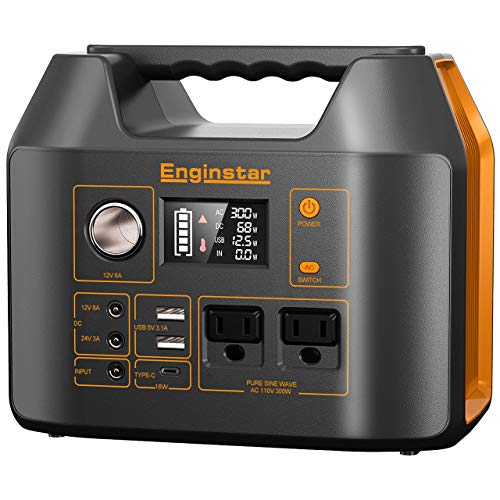
| High-Capacity Workhorse | Battery Capacity: 296 Wh | AC Output (rated): 300 W continuous (2 × 110 V AC pure sine) | USB / USB-C Charging: 2 × USB‑A (5V/3.1A) + 1 × USB‑C (18W) | VIEW LATEST PRICE | Read Our Analysis |
| 300W Portable Power Station 280Wh Solar Generator |

| Balanced All-Rounder | Battery Capacity: 280 Wh | AC Output (rated): 300 W rated (2 × 110 V AC) | USB / USB-C Charging: 3 × USB‑A (5V/3A) + 1 × QC USB‑A (multi‑voltage) | VIEW LATEST PRICE | Read Our Analysis |
| 300W Portable Solar Generator with 60W Foldable Panel |

| Best Solar Combo | Battery Capacity: 280 Wh | AC Output (rated): 300 W max (2 × 110 V AC) | USB / USB-C Charging: 3 × USB‑A (5V/3A) + 1 × Quick Charge USB‑A + USB‑C on panel | VIEW LATEST PRICE | Read Our Analysis |
More Details on Our Top Picks
MARBERO 88Wh Portable Power Station Solar Generator
The MARBERO M82 (88Wh) suits van lifers who prioritize a lightweight, compact power source for small electronics and short excursions: its DSLR-sized form, 1.04 kg weight, and 80 W continuous output provide portable, safe power for phones, laptops, USB‑C devices, and small 230 V appliances, while fast charging, pass‑through capability, and optional solar input make it practical for on-the-road top‑ups and emergency backup. The M82 offers eight outputs (AC, DC, USB, USB‑C PD), 120 W peak, rapid 0→80% charging in two hours, UL-tested cylindrical cells, BMS protections, rear cooling vents, an adjustable LED light with SOS mode, and included adapter and car cable.
- Battery Capacity:88 Wh
- AC Output (rated):80 W continuous (120 W peak), 230 V AC
- USB / USB-C Charging:USB ports + USB‑C PD (multiple USB outputs)
- DC / Car Output:Car DC output (cigarette lighter) included
- Solar Charging Compatible:Compatible with MARBERO 30W/60W solar panels (optional)
- Built-in Safety / BMS:BMS with voltage, temperature, short‑circuit, overload, over‑charge/over‑voltage protection; UL drop tested
- Additional Feature:Super-slim DSLR-sized
- Additional Feature:3-level SOS LED
- Additional Feature:Fast 0→80% (2h)
Powkey 200W Portable Power Bank with AC Outlet
Offering a compact 146Wh pack with two pure-sine 110V AC outlets and multiple USB ports, the Powkey 200W suits van lifers who prioritize running small appliances and charging devices without adding bulk. Its two AC sockets deliver a combined 200W max (check device draw), supported by four USB ports and one DC port for flexible charging. The 146Wh Li‑Po battery weighs 3.0 lbs (4 lbs with accessories) and measures 7.87 x 1.81 x 5.71 in. Fast DC input recharges in about 5–6 hours; four LEDs show charge level. Safety features include OCP, OVP, short‑circuit protection, UL and UN38.3 certifications, plus a 30‑day return policy.
- Battery Capacity:146 Wh
- AC Output (rated):200 W max (2 × 110 V AC pure sine)
- USB / USB-C Charging:4 × USB ports (no specific USB‑C noted)
- DC / Car Output:1 × DC port
- Solar Charging Compatible:Not explicitly bundled; supports external charging (solar compatibility implied via DC input)
- Built-in Safety / BMS:Protections: OCP, OVP, short circuit protection, auto power‑off; multiple certifications (CE, FCC, RoHS, UL)
- Additional Feature:Pure sine AC
- Additional Feature:4-level LED indicators
- Additional Feature:UL/MSDS/UN38.3 certified
EnginStar 300W Portable Solar Power Station 296Wh
For van dwellers who need a compact, everyday power hub rather than a high-output generator, the EnginStar 300W Portable Solar Power Station (296Wh) fits the bill. It weighs 6.5 lb and measures 9 x 5.5 x 7.5 inches, offering 296 Wh lithium-ion capacity and 300W continuous pure sine wave output. Outputs include two 110V AC outlets, a 12V car port, 12V/8A and 24V/3A DC ports, two USB-A ports, and an 18W USB-C. Charging via AC (≈3 hours), solar or car; built-in LED, LCD, and smart BMS protect the battery for 1,000+ cycles. Not for high-draw appliances.
- Battery Capacity:296 Wh
- AC Output (rated):300 W continuous (2 × 110 V AC pure sine)
- USB / USB-C Charging:2 × USB‑A (5V/3.1A) + 1 × USB‑C (18W)
- DC / Car Output:12V car port + additional DC outputs (12V/8A, 24V/3A)
- Solar Charging Compatible:Solar input supported (panel sold separately)
- Built-in Safety / BMS:Smart BMS protecting against overload, over‑discharge, overcharge, overheating, short circuit
- Additional Feature:Large LCD display
- Additional Feature:1,000+ charge cycles
- Additional Feature:Multiple DC voltage outputs
300W Portable Power Station 280Wh Solar Generator
Compact yet capable, the W Portable Power Station 280Wh is ideal for van lifers who need reliable, mid-range power for electronics and small appliances without adding heavy gear. It houses a 280Wh lithium-ion pack with dual 110V AC outlets rated 300W, a DC output (9–12.6V/10A), three 5V USB ports, and one QC USB port. Weighing about 5 lbs, it includes MPPT solar input, wall and 12V car charging cables; solar panels sold separately. Built-in BMS and intelligent cooling protect against faults and heat. Suitable for phones, laptops, lighting and small appliances under 300W; avoid high-draw compressor or heating devices.
- Battery Capacity:280 Wh
- AC Output (rated):300 W rated (2 × 110 V AC)
- USB / USB-C Charging:3 × USB‑A (5V/3A) + 1 × QC USB‑A (multi‑voltage)
- DC / Car Output:1 × DC output (9V–12.6V / 10A) + car charging cable included
- Solar Charging Compatible:DC5521 solar input with built‑in MPPT (solar panel sold separately)
- Built-in Safety / BMS:Built‑in BMS with short‑circuit, over‑current, over‑voltage, overload protection; intelligent cooling
- Additional Feature:Built-in MPPT
- Additional Feature:Intelligent cooling fan
- Additional Feature:Auto AC output check
300W Portable Solar Generator with 60W Foldable Panel
The W Portable Solar Generator with its 280Wh capacity and included 60W foldable monocrystalline panel is best for van lifers who need a reliable, mid-range power solution for phones, laptops, and small appliances without heavy-draw devices. It pairs a 300W inverter (300W max) and 280Wh battery with 2 AC outlets, multiple USB ports, a DC port, and Quick Charge support. The 60W panel (20.5% efficiency) and MPPT-equipped junction enable faster solar recharging; junction box must stay dry. A built-in BMS, thermal fan, and multiple protections improve safety. Includes AC adapter, car cable, panel kit, manuals, and 24/7 support.
- Battery Capacity:280 Wh
- AC Output (rated):300 W max (2 × 110 V AC)
- USB / USB-C Charging:3 × USB‑A (5V/3A) + 1 × Quick Charge USB‑A + USB‑C on panel
- DC / Car Output:1 × DC port (9V–12.6V / 10A) + car charging cable included
- Solar Charging Compatible:Includes 60W foldable solar panel (DC5521 MPPT supported)
- Built-in Safety / BMS:Built‑in BMS with short‑circuit, over‑current, over‑voltage, overload, overheating protection; automatic cooling fan
- Additional Feature:Included 60W foldable panel
- Additional Feature:20.5% mono efficiency
- Additional Feature:USB-C solar output (15V/2A)
Factors to Consider When Choosing a Power Bank For Van Life
When I pick a power bank for van life I look first at capacity and real-world runtime so my devices and small appliances actually stay powered. I also check the available output types and charging speeds, plus whether it’s lightweight enough to carry and can accept solar input for boondocking. Those factors together tell me if a unit will fit my setup and travel style.
Capacity And Runtime
Because I live in a van, I always start capacity planning by estimating total daily watt-hours from every device I’ll run—laptop 50W×4h = 200 Wh, fridge 40W×24h = 960 Wh, lights 10W×5h = 50 Wh—and then choose a battery that covers that load plus a safety margin. I plan for 25–50% extra to handle cloudy days, inefficiencies, and surprises. I never assume 100% usable energy: inverter and conversion losses eat 10–20%, and many chemistries limit usable depth of discharge. For multi-day boondocks I pick several hundred to over a thousand Wh or pair storage with solar so runtime isn’t solely battery-limited. Finally, I balance Wh against weight and space—more capacity equals longer runtime but also more mass and footprint.
Output Types Available
Start by matching outputs to the gear you actually use so you don’t wind up with the wrong ports in a pinch. I prioritize AC outlets (pure sine wave when possible) for laptops and small appliances that need stable 110–230V power. I also want USB-C PD ports delivering roughly 18–60W to fast-charge modern laptops, tablets, and phones. Multiple USB-A ports (5V/2–3A) and QC-enabled sockets let me top off phones, cameras, and accessories simultaneously. For automotive gear I need a 12V DC/car-style output or cigarette-lighter port to run fridges and pumps. Finally, I always check continuous and peak (surge) wattage specs so motors or compressors with high starting currents won’t overload the unit.
Charging Speed Options
Think about charging speed in two parts: capacity (watt‑hours) and how fast the bank can push power out and take power in. I always check Wh and maximum continuous output watts — Wh tells me runtime, output watts tell me which devices I can run and how many at once. I favor USB‑C Power Delivery and, when needed, pure‑sine AC rated to match device input; PD at 45–100W handles most laptops. Fast input rates (30–60W+) and multi‑input options (AC/solar/car) cut recharge time substantially. I also verify pass‑through capability and the combined power budget so protections don’t kick in when charging while discharging. Finally, I confirm fast‑charge protocols and per‑port voltage/current specs to guarantee phones and tablets get their top supported rates.
Portability And Weight
Having covered how output and recharge rates affect what you can run, let’s look at how weight and size affect how you live with a power bank in a van. I pick units under about 5 lbs when I need to carry them regularly — anything 10+ lbs becomes a chore and eats payload. Measure your cubby or locker and favor slim, DSLR-sized banks that tuck into tight spaces. I check energy density (Wh/kg) so I get more usable capacity for each pound I haul. Don’t forget accessories: chargers and cables add up, and frequent transport multiplies that cost. Finally, balance portability against runtime — lighter packs are easier to handle but may force more frequent recharges or multiple units for multi-day off-grid stretches.
Solar Charging Compatibility
Because solar is often the lifeline for multi-day off-grid stretches, I prioritize power banks whose solar inputs and charge controllers are genuinely designed for panels, not just labeled “solar-ready.” Look for a dedicated solar input with MPPT or a built-in solar charge controller to squeeze maximum watts from your panels and cut charge times. Match your panel Vmp/Imp and connector type to the bank’s specs to avoid underperformance. Compare accepted solar charging wattage to your panel capacity—30–100W inputs recharge much faster. Confirm the battery management system allows pass-through and protects against overcharge, over-voltage, and reverse current when tied to panels. Finally, estimate realistic charging hours: battery Wh divided by effective panel W, factoring orientation, shading, and 60–75% real-world efficiency.
Safety And Durability
While I’ll chase capacity and solar performance, I won’t compromise on safety and durability when I’m living on the road. I pick power banks with an integrated BMS that guards against over-charge, over-discharge, over-voltage, over-current, short circuits, and temperature issues — that’s nonnegotiable for fire and failure prevention. I prefer units using UL/CE/FCC/ROHS or UN38.3 certified cells, ideally high-quality Li-ion or Li‑poly cells rated 500–1,000+ cycles. Good thermal management matters: intelligent cooling, vents, or automatic fans reduce risk under heavy loads. Mechanical robustness is next — ABS or reinforced housings, drop-test specs and IP or splash resistance if I expect rough handling. Finally, I verify warranty length, accessible support, and clear maintenance guidance to preserve battery health and safe long-term use.
Temperature And Ventilation
If I keep a power bank in a hot van without thinking about ventilation, its capacity will drop and it can get permanently damaged—so I always store units out of direct sun and in shaded, ventilated spots to stay below roughly 45°C (113°F). I also avoid airtight compartments, leaving several centimeters clearance so heat can dissipate. In cold weather I’ll keep batteries insulated or bring them into the cabin, since sub‑0°C (32°F) temps reduce usable capacity and raise internal resistance. When I run high continuous loads or fast charge, I use ventilation or intermittent cycles to prevent internal temps climbing into the 40–60°C danger zone. I monitor temperature with built‑in indicators or a thermometer and stop charging if a unit feels unusually hot.
Maintenance And Storage
Storing and maintaining your power bank right will keep it reliable on the road and extend its life. I store lithium packs around 40%–70% charge and top them up every 3–6 months so they don’t slip into protection lockout or lose capacity. I keep them in a cool, dry place—ideally 4°C–35°C—and out of direct sun to avoid faster degradation. Every few months I run a full charge to 100% and discharge to about 20%–30% to recalibrate the battery management system. I inspect cables, ports, and casings for damage, clean contacts with a dry cloth, and make sure good ventilation while charging. For long storage I power units off and aim for roughly 50%, checking every three months.
