Tokyo in 2025 is a top destination, a city where futuristic innovation meets deep-rooted culture. I find its unique appeal truly captivating. This vibrant metropolis offers a world-class culinary scene alongside cutting-edge technology. My travel to Tokyo revealed a place where tradition thrives. It is a significant economic contributor; Japan’s tourism added ¥13.2 trillion to its economy, with Tokyo attracting an estimated 16 million visitors in 2024. The city’s charm makes every trip an unparalleled adventure. It truly is a cultural highlight.
Tokyo’s Culinary Journey: Best Eats in 2025

I find Tokyo’s food scene truly diverse. It offers everything from Michelin-starred restaurants to casual street food. This section will guide you through the city’s culinary highlights. You will discover the best places to eat in 2025.
Michelin Stars and Fine Dining
Tokyo boasts an impressive number of Michelin-starred restaurants. These establishments offer exceptional dining experiences. I always recommend Ginza for fine dining. It has many top-tier options. For 2025, several restaurants earned new stars or promotions.
| Restaurant Name | Star Status (2025) | Culinary Specialty |
|---|---|---|
| SÉZANNE | Three Stars (Promoted from Two) | French (fusion of French essence with Japanese ingredients) |
| Tempura Motoyoshi | Two Stars (Promoted from One) | Tempura (molecular gastronomy approach) |
| ESqUISSE | Two Stars | French |
| Primo Passo | One Star (Promoted) | Italian (refined pasta dishes with Japanese twists) |
| Yakitori Takahashi | One Star (Promoted) | Yakitori (perfectly cooked chicken) |
| Héritage by Kei Kobayashi | One Star (Promoted) | Contemporary French |
| Yama | One Star | Dessert-only (elegant creations based on local seasonal fruits) |
| Sanosushi | One Star | Sushi (outstanding tuna) |
| Kappo Muroi | One Star | Traditional Japanese |
| Yotsuya Minemura | One Star | Traditional Japanese |
| Higashiyama Muku | One Star | Traditional Japanese |
| CYCLE by Mauro Colagreco | One Star | Modern French (incorporating Japanese ingredients) |
| apothéose | One Star | Modern French (incorporating Japanese ingredients) |
| hortensia | One Star | Modern French (incorporating Japanese ingredients) |
| Saucer | One Star | Modern French (incorporating Japanese ingredients) |
| Hakunei | One Star | French and Japanese fusion |
| Daigo | One Star & Green Star | Shojin cuisine (traditional vegetarian Japanese) |
Authentic Local Flavors: Izakayas, Ramen, Sushi
Tokyo’s local food scene offers incredible flavors. I often visit Shibuya or the Tsukiji Outer Market for these authentic tastes.
Izakayas are Japanese pubs serving small dishes. They are perfect for a casual meal.
- Kotaro (高太郎): This is an upscale izakaya. It offers refined Japanese classics. Signature dishes include Smoked Potato Salad and Menchi Katsu.
- Kishidaya (岸田屋): An old-school spot, popular with locals. I enjoy their Gyu-nikomi (beef stew) and Grilled Fish.
- Kanemasu (かねます): This rustic izakaya focuses on seafood. It is near Tsukiji market. Try their Uniku (beef roll with uni) and Hairy Crab Salad.
- Maguro Mart (マグロマート): This izakaya specializes in tuna. They serve various parts of tuna in many ways.
Ramen is a must-try. Tokyo has many unique ramen shops.
- Ramen Maji: They specialize in Tai (Sea Bream) Shio Ramen. It is a unique salt ramen.
- Kikanbo Kanda Honten: This shop is famous for its spicy Karashibi Miso Ramen. You can customize the spice level.
- Ramen Takahashi: They feature Yaki Ago (grilled flying-fish) Shio Ramen. It has a smoky aftertaste and rich umami broth.
- Afuri Harajuku: Known for its Yuzu Shoyu Broth ramen. This ramen has a zesty and light taste.
Sushi in Tokyo is world-class. Many restaurants offer traditional Edo-mae style sushi. The omakase experience lets the chef choose your meal.
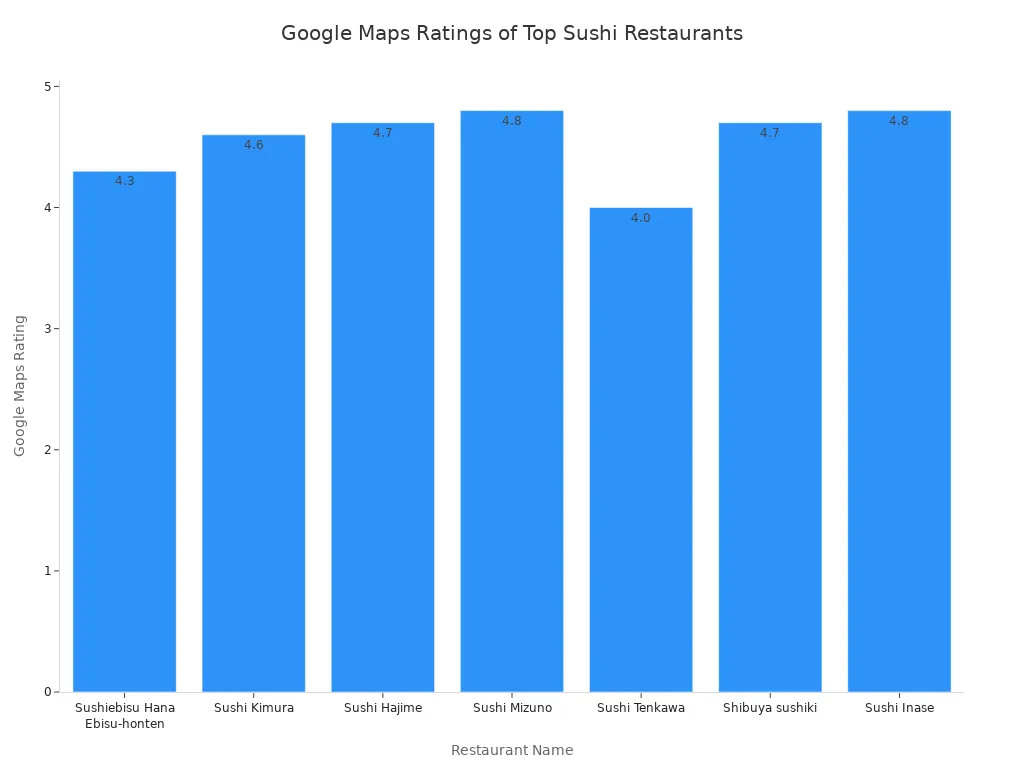
This above A bar chart showing Google Maps ratings for various sushi restaurants in Tokyo and I hope you will like it.
Trendy Cafes and Unique Desserts
Tokyo’s cafe scene is vibrant. Harajuku is a great district for trendy cafes. You can find unique desserts and innovative coffee preparations there. I also recommend checking out the second floor of the Tokyo Skytree mall for Japanese snacks.
- Koffee Mameya Kakeru: This cafe offers an immersive experience. Their ‘Kakeru omakase’ focuses on coffee education. Guests can sample various roasts. They serve cold brew, pour-over, and innovative cocktails.
- Cokuun: This cafe features a coffee omakase concept. It draws inspiration from Japanese tea ceremonies. The 90-minute course includes specific tools and pairings.
- Lonich: A newer cafe in Kuramae. It offers several omakase courses. They source about 20 different filtered coffees. Courses include the Seasonal Omakase and the Japanese-Chinese Ingredient Fusion course.
Immersive Food Experiences: Classes and Tours
For a deeper dive into Japan’s culinary world, consider a cooking class or a food tour. These experiences offer hands-on learning and local insights.
Cooking Classes:
| Cooking Class | Dishes Taught |
|---|---|
| Creative Japanese Cooking in a Modern Tokyo Home | Sushi or Nikujaga (meat and potato stewed in soy and mirin), Salmon sauté, Shabu shabu salad or Silken tofu topped with hijiki seaweed and beans, Onigiri (Japanese rice balls with pickles), Amazake (sweet, non-alcoholic sake). |
| Wagyu Beef and Kaiseki Ryouri Tokyo Cooking Class | Up to eight dishes featuring Wagyu beef, Japanese vegetables, traditional seasonings, Dashi, 6-7 classic and modern recipes, elaborate cuttings, and unique Japanese ingredients. |
| Sushi Masterclass in Tokyo | Proper use of Japanese kitchen knives and sushi tools, cutting and preparing sushi sashimi, grinding wasabi, making sushi rolls, and cooking a Japanese omelette with multiple layers. |
Food Tours:
- Tokyo Night Foodie Tour in Shinjuku – Seasonal Sushi & Wagyu Beef: This tour offers a high-end dining experience. It focuses on premium seasonal sushi and wagyu beef.
- Tokyo Bar Hopping Tour in Shinjuku (All-You-Can-Drink + Dinner): This tour explores Shinjuku’s backstreets. It offers bottomless drinks and continuous food at local izakayas.
- Eat and Drink Like a Local: Tokyo Ueno Food Tour – Taverns & Ramen: This tour explores everyday Japanese dining in Ueno. It features ramen shops and casual taverns.
- Tokyo Tsukiji Fish Market Food and Culture Walking Tours: This morning tour focuses on the legendary Tsukiji Fish Market. Options include a ‘Food + Culture Walking Tour’ or a ’14-Stop Food Tour’.
- Tokyo: Yakatabune Dinner Cruise with Japanese Show & Drinks: This is a unique immersive experience on a traditional yakatabune boat. It offers dinner, drinks, and a Japanese show. You also get views of the Tokyo skyline. These highlights make for memorable culinary experiences.
Exploring Modern Tokyo: A Glimpse into the Future

I find modern Tokyo a fascinating blend of innovation and excitement. This section explores the city’s contemporary and futuristic attractions. You will discover many things to do in Tokyo. These sights offer a glimpse into Japan’s cutting-edge urban landscape.
Iconic Skyscrapers and Observation Decks
Tokyo’s skyline is impressive. I enjoy visiting its many skyscrapers with public observation decks. They offer breathtaking views. Here are some highlights:
| Skyscraper | Operating Hours | Admission Fees | Deck Height |
|---|---|---|---|
| Tokyo Skytree | 10:00 to 22:00 (from 9:00 on Sundays and national holidays) | 2400-2600 yen (first deck), 3500-3800 yen (both decks) | 350 meters (first deck), 450 meters (second deck) |
| Tokyo Tower | 9:00 to 23:00 (entry until 22:30) | 1200 yen (main deck), 3000 yen (both viewing decks) | 150 meters (main deck), 250 meters (top deck) |
| Shibuya Sky | 10:00 to 22:30 (entry until 21:20) | 2500 yen (2200 yen if purchased online) | 229 meters (46th floor) |
| Roppongi Hills | 10:00 to 22:00 | 2000 yen (discounted if purchased online) | 218 meters |
| Tokyo Metropolitan Government Building | 9:30 to 22:00 (entry until 21:30) | Free | 202 meters (45th floor) |
| Sunshine 60 | 10:00 to 21:00 (entry until 20:00) | 700-1200 yen depending on the day | 226 meters |
For Tokyo Skytree, I know advance tickets for the Tembo Deck cost ¥1,800 on weekdays and ¥2,000 on weekends. Same-day tickets are slightly more. Combo tickets for both decks range from ¥2,700–¥3,400.
Tech and Entertainment Hubs
Tokyo is a global leader in technology and entertainment. I always find Akihabara and Odaiba exciting. These areas offer unique experiences.
- Akihabara: This district, known as Electric Town, is a hub for tech lovers. It features electronic stores, arcades, and manga/anime shops. I see neon lights illuminating the streets near JR Akihabara Station. Akihabara Radio Kaikan is a landmark building here. It houses popular electronics and anime goods shops. The area also offers immersive pop culture experiences through maid and manga cafes.
- Odaiba: This ultramodern entertainment island sits on Tokyo Bay. It offers pleasure cruising, shopping, and seaside fun. I recommend the National Museum of Emerging Science and Innovation (Miraikan). Visitors can experience advancements in robotics and AI. You can even interact with robots like ASIMO. The life-sized UNICORN GUNDAM Statue outside DiverCity Tokyo Plaza is another highlight.
Fashion, Shopping, and Pop Culture
Tokyo sets global trends in fashion and pop culture. I find Shibuya and Harajuku particularly vibrant. These districts offer diverse shopping and style.
- Shibuya 109: This is a top destination for trendy, fast fashion. It showcases unique Japanese street styles.
- Laforet Harajuku: I consider this the heart of Tokyo’s alternative fashion scene. It features quirky, experimental, and indie fashion brands.
- Shibuya Parco: This mall offers cutting-edge fashion, pop culture, and technology. It houses streetwear, designer brands, and exclusive concept stores. It is also a hub for gaming and anime culture.
- DiverCity Tokyo Plaza: Located in Odaiba, this mall is famous for its pop culture attractions. It includes the life-size Gundam statue.
Urban Green Spaces and Relaxation
Despite its modernity, Tokyo offers many serene green spaces. I appreciate these spots for relaxation. Tokyo is recognized as a leading global city for green spaces. It boasts 159 parks and natural attractions.
- Shiba Park: This park offers proximity to the city’s activity.
- Shinjuku Gyoen National Garden: I find its serene atmosphere perfect for a quiet escape.
These urban oases provide a peaceful contrast to the city’s bustling energy. They are great for various activities.
Embracing Tradition: Tokyo’s Cultural Heartbeat
I find Tokyo’s rich historical and cultural heritage truly captivating. This section explores the city’s deep roots. It shows how ancient traditions thrive alongside modern life.
Ancient Temples and Shrines
Tokyo offers many sacred sites. I always recommend visiting Senso-ji Temple and Meiji Jingu Shrine. These are significant cultural highlights.
- Senso-ji Temple: This is Tokyo’s oldest temple. Its history dates back to 645. American bombing destroyed much of it during World War II. Workers rebuilt the temple in 1958. The Kaminarimon gate is a prominent feature. It lights up and houses the gods of wind and thunder. Nakamise Dori, a street with souvenir shops, leads to the main hall.
- Meiji Jingu Shrine: This shrine honors Emperor Meiji and Empress Shoken. It was established in 1920. Public donations helped build it. A man-made forest of over 100,000 trees surrounds it. The shrine was rebuilt in 1958 after wartime destruction. Its design shows traditional Japanese simplicity and grandeur. Massive torii gates, some 12 meters tall, mark its entrance.
Historic Districts and Traditional Arts
Exploring Tokyo’s historic districts reveals traditional arts. I enjoy seeing these cultural activities. Visitors can experience traditional Japanese arts like ikebana and tea ceremonies.
- Ikebana: You can learn ikebana, the art of flower arrangement. Sandan-zaka no Wakan offers a private ikebana experience. An Ikenobo master teaches you. Sogetsu Kaikan also provides lessons. Koboji Temple combines meditation with ikebana.
- Tea Ceremony: Many places in Tokyo offer traditional tea ceremonies. You can learn about its etiquette and spiritual meaning. This is a peaceful cultural activity.
Museums Showcasing Japanese Heritage
Tokyo has excellent museums. They showcase Japan’s rich heritage. The Tokyo National Museum is a prime example. It is one of the best attractions.
| Building Name | Primary Collections/Function |
|---|---|
| Honkan (Main Gallery) | Japanese Art (Prehistory to Edo Period), Buddhist Art, Samurai Armor and Swords, Ukiyo-e |
| Heiseikan | Japanese Archaeology (Paleolithic, Jomon, Yayoi, Kofun periods), including Jomon pottery and haniwa |
| Horyuji Homotsukan (Gallery of Horyu-ji Treasures) | Treasures from Horyu-ji Temple (Buddhist sculptures, ritual objects from 7th and 8th centuries) |
| Kuroda Kinenkan (Memorial Hall) | Works by Seiki Kuroda and other artists influenced by Western-style painting in Japan |
| Toyokan (Asian Gallery) | Art and Archaeology of Other Asian Countries |
Traditional Performances and Festivals
Tokyo offers many traditional performances and festivals. These cultural highlights provide unique experiences.
- Traditional Performances:
- Kabuki: You can see classic performances at the National Theatre.
- Noh: The National Noh Theatre offers performances year-round. They provide support for English speakers.
- Bunraku: This puppet theater is another prominent art form in Japan.
- Festivals: Tokyo hosts many vibrant festivals throughout the year. These are major highlights.
| Festival Name | Month/Dates (2025) |
|---|---|
| Kanda Matsuri | May 10 |
| Sanja Matsuri | May 16-18 |
| Hachioji Matsuri | August |
| Mitama Matsuri | July |
| Kagurazaka Matsuri | July |
| Azabu Juban Noryo Matsuri | August |
| Fukagawa Hachiman Matsuri | August |
| Tori no Ichi | November 12 and 24 |
| Kurayami Matsuri | April 30 – May 6 |
Planning Your Travel to Tokyo in 2025
I find planning a trip to Tokyo exciting. This section offers essential advice for travelers. It covers everything from the best times to visit to practical tips for your journey. I want to help you prepare for an amazing travel to Tokyo.
Best Time to Visit and Seasonal Highlights
Choosing the right time for your trip makes a big difference. I always consider the weather and seasonal events. Here is a guide to the best times to visit Tokyo:
| Season | Months | Weather | Highlights | Peak Bloom/Foliage |
|---|---|---|---|---|
| Spring | March to May | Mild, 10–19°C (50–67°F), around 10 rainy days | Cherry Blossoms | Late March to mid-April, peak March 28 – April 4 |
| Autumn | September to November | Cool, 15–22°C (59–72°F), drier | Autumn Foliage | Late October, peaks in November |
| Note | September | Typhoon season, late September has low typhoon probability |
I find spring and autumn offer the best times to visit Tokyo. The weather is pleasant. You can enjoy beautiful natural highlights. Early April and May have pleasant temperatures. April is perfect for the Sakura season.
Tokyo’s peak tourist season includes mid-June through mid-September, and late April through early May. During the summer months (June-September), the weather is typically very hot and humid. This coincides with the rainiest part of the year from early June to late July. August experiences peak heat and dense crowds due to summer vacation. September marks the start of fall. It is the darkest and wettest month. Temperatures gradually decline later in the month.
I advise avoiding Golden Week. This period runs from late April to early May. Accommodation becomes very challenging during this time. Many Japanese people travel, making hotels and transport very busy.
I recommend at least one week for your trip. This gives you enough time to explore Tokyo. For first-time visitors to Japan, a two-week itinerary allows you to see Tokyo and other regions. I always check fall foliage forecasts for Fall 2025. This helps me plan my autumn itinerary.
Navigating Tokyo: Transportation and Connectivity
Tokyo has an excellent public transport system. I find it very efficient for getting around Tokyo.
- Suica Card: This is a prepaid, tap-and-go IC card. It works on almost all Tokyo trains, subways, and buses. The ‘Welcome Suica’ for tourists is very flexible. You can use it on Tokyo Metro, Toei Subway, JR-operated lines, local buses, and select Shinkansen routes. You reload it with credit. It allows payment for each fare separately.
- Tokyo Subway Ticket: This ticket offers unlimited rides on Tokyo Metro and Toei Subway lines. It is ideal for 1-3 days of sightseeing. You can buy it for 24, 48, or 72 hours.
- Japan Rail (JR) Pass: This pass provides unlimited rides on JR trains across Japan. It includes Shinkansen and airport trains. You can use it for JR-operated metro lines in Tokyo.
I always download a subway app. Apps like ‘Tokyo Metro my!’ and ‘Japan Travel – Trip, Transit & Rail (Navitime)’ offer route options. They also provide real-time crowding information and ticket details. This ensures smooth travel. Trains generally run from 5 am to around midnight. I always confirm my route using a travel app or online. I try to avoid rush hour. Tokyo’s rush hour is approximately 7:30-9:30 am and 5:30-7:30 pm. Mornings are usually more crowded. Avoiding these times is advisable if you dislike crowds or have large luggage.
For connectivity, I consider several options. Free public Wi-Fi is not as widely available in Japan as in some other countries. Hotspots are often limited to major chain cafes, hotels, and some train stations.
Public Wi-Fi networks may require time-consuming logins. They can be unreliable. They may also have usage restrictions. Relying solely on public Wi-Fi poses security risks due to shared networks. This makes it less ideal for sensitive information.
Pocket Wi-Fi is one of the easiest and most convenient ways for tourists to stay connected in Tokyo. Rental kiosks are available at Haneda and Narita Airports. They offer various plans. Booking in advance can sometimes lead to cheaper rates. This may exclude airport taxes. Units can even be delivered directly to your hotel. Pocket Wi-Fi is an excellent choice for groups or travelers with multiple devices. It can connect up to 5 devices simultaneously.
It requires regular charging. You must return it at the end of the rental period. Its reliability and flexibility make it a popular option for connecting to Wi-Fi in Japan.
Travel SIM cards can be purchased upon arrival in Japan. Kiosks, major convenience stores, vending machines at airports, and electronics megastores like BIC Camera and Yodobashi Camera sell them. Prices typically range from 2,000 to 8,000 yen. This depends on the plan.
I advise researching price plans online beforehand. I also inquire with store staff. Many of them are bilingual. They can offer recommendations. Some free SIM options may also be available for visitors. Conditions apply.
- A SIM card is inserted directly into your phone. This means no extra device to carry.
- It offers unlimited mobility. It provides unrestricted connectivity wherever you go. This is unlike pocket Wi-Fi with its limited range.
- No need for charging. It works as long as your phone has power.
- It is more cost-effective for solo travelers compared to pocket Wi-Fi. Pocket Wi-Fi is often more expensive for individual users.
- SIMs are ideal for short-term visitors. They offer reliable internet without long-term commitments.
- They come with fixed data allowances and validity periods (e.g., 8, 16, or 31 days).
- No contracts are required. You simply purchase, insert, and activate.
- Flexible data plans are available (e.g., 3GB, 5GB, or unlimited).
- Some providers offer pre-arrival delivery to your home country.
- Setup is easy with step-by-step instructions.
- Most prepaid SIMs are data-only. Communication apps like LINE and WhatsApp can be used for calls and SMS.
- Example plans include NINJA WiFi’s 7-day (1GB/day) for 3,795 yen and 15-day (1GB/day) for 4,422 yen.
- SIM cards are perfect for solo travelers or those seeking a lightweight and cost-effective solution. They are limited to one device. They require an unlocked phone to function.
eSIMs provide a cutting-edge solution for tech-savvy travelers. They offer unmatched convenience with instant activation and no physical components. Device compatibility is essential for using an eSIM.
- Instant activation happens by scanning a QR code. This eliminates the need to visit a store or wait for delivery.
- No physical card means no risk of loss or damage.
- Multiple data plans are available. They suit travel duration and usage needs.
- It supports dual SIM functionality. This allows users to keep their home country’s SIM active for calls. They use the eSIM for data.
- Example plans include NINJA WiFi’s 15-day (20GB) for 6,204 yen or 21-day (20GB) for 6,457 yen for longer stays.
The best connectivity option among Pocket Wi-Fi, eSIM, or SIM Card depends on your travel style, budget, and device compatibility. Considering your travel plans and connectivity needs will help you select the option that best enhances your experience in Japan.
Accommodation Options for Every Budget
Tokyo offers a wide range of accommodation options. I find choices for every budget and travel style. This helps manage the cost of your trip.
| Neighborhood | Travel Style/Interests | Budget | Recommended Hotels (Examples) |
|---|---|---|---|
| Ueno | Museum lovers, art and culture enthusiasts, families, longer stays | More affordable | N/A (general recommendation to browse Agoda/Booking.com) |
| Ikebukuro | Budget-conscious travelers, shoppers, those who don’t mind longer commutes | Budget-friendly (cheaper than Shibuya/Shinjuku) | Kimi Ryokan (traditional, budget), Dormy inn Ikebukuro Hot Spring (modern, hot spring) |
| Akasaka | Foodies (excellent restaurants), those seeking hidden gems, convenient metro access | Affordable yet quality (often cheaper than Shibuya/Ginza for similar value) | Hotel Hillarys Akasaka (affordable), Super Hotel Premier Akasaka (affordable), Via Inn Prime Akasaka (mid-range), OMO3 Tokyo Akasaka by Hoshino Resort (mid-range), The Kitano Hotel Tokyo (luxury), The Capitol Hotel Tokyu (luxury) |
| Asakusa | Charming atmosphere, cultural experiences (Senso-ji Temple), views of Tokyo Skytree, convenient for Ueno/Skytree/Nikko | Affordable, Mid-range, Luxury | APA Hotel Asakusa Kaminarimon (affordable), Onyado Nono Asakusa Hot Springs (mid-range), SAKE Bar Hotel Asakusa (mid-range), The Gate Hotel Kaminarimon by Hulic (luxury) |
| Ginza | Luxury shopping, fine dining, central location, kabuki theater, parks | Upscale (luxury), some affordable options | Sotetsu Fresa Inn Ginza (affordable), Muji Hotel Ginza (luxury, minimalist), Imperial Hotel Tokyo (classic luxury) |
I always consider my itinerary and interests when choosing a neighborhood. This helps me estimate how much does a Tokyo trip cost.
Essential Tips for Traveling to Tokyo
I have some essential tips for traveling to Tokyo. These will help ensure a smooth and enjoyable trip.
First, let’s talk about visas. A valid passport is required for the entire duration of your stay in Japan. You should have proof of a return or onward ticket available. Working in the local economy is prohibited. You cannot change to another visa type while in Japan. You must leave and re-enter with the correct visa. Immigration officers may deny entry if proof of financial self-support is lacking. They may deny exit if you have unpaid bills.
All visitors must provide fingerprints and have their photo taken upon arrival. Exceptions exist for diplomatic visa holders, minors, and certain military personnel on official orders.
For temporary visitors to Japan, engaging in paid activities is not permitted. However, short-term studies at Japanese language schools are allowed. All foreign tourists must carry their passports at all times. Japan plans to introduce an ESTA-style pre-registration system from April 2028. This will require temporary visitors under the visa-waiver program to submit personal information and pay a fee before arrival.
Citizens from over 50 countries with a general visa exemption arrangement may qualify for longer stays. If you have savings exceeding 30 million yen, you and your spouse can stay for up to one year for sightseeing and recreation. Professionals with an annual income over 10 million yen may qualify to work remotely for up to six months.
Both categories require obtaining specific visas (‘long-term residents for sightseeing/recreation’ or ‘digital nomads’) before traveling to Japan.
| Category | Countries Eligible for Visa Waiver (Examples) | Countries Requiring Tourist Visa (Examples) |
|---|---|---|
| North America | Canada, United States | N/A |
| Latin America & Caribbean | Argentina, Chile, Mexico, Bahamas | N/A |
| Asia | Brunei (15 days), Republic of Korea, Thailand (15 days), Singapore, Hong Kong, Taiwan | China, Russia, Philippines, Vietnam, CIS countries and Georgia |
| Oceania | Australia, New Zealand | N/A |
| Middle East | Israel, United Arab Emirates (30 days), Turkey | N/A |
| Africa | Lesotho, Tunisia, Mauritius | N/A |
General Tourist Visa Requirements:
- Valid passport (at least 6 months remaining, 2 blank pages)
- Completed visa application form
- Recent color passport photo and certified birth certificate copy
- Marriage certificate (if applicable, issued within last year)
- Intention to leave Japan at the end of authorized stay
- Proof of financial ability (bank certificate for previous 6 months, tax return)
- Certificate of Employment (if applying without a sponsor)
- Schedule and travel plans for the trip
Single-entry tourist visas are valid for 3 months from issue. They allow stays up to 90 days. You cannot extend them. Double-entry visas are valid for 6 months from issue. Multiple-entry visas are typically valid for 1 to 5 years. This depends on nationality and purpose. They allow multiple visits within that period. Each stay cannot exceed 15 or 30 days. Visa fees vary based on the type of visa and nationality. I advise checking with the Japanese embassy or consulate. Fees are subject to change. They are collected in local currency at the time of application.
I also recommend learning some basic Japanese phrases. This helps with communication.
- Basic Greetings:
- Ohayou gozaimasu (Good morning)
- Konnichiwa (Hello)
- Konbanwa (Good evening)
- Key Polite Expressions:
- Arigatou gozaimasu (Thank you very much)
- Sumimasen (Excuse me/Sorry)
- Onegaishimasu (Please, for requests)
- Sayonara (Goodbye, formal)
- Ja mata (See you later, casual)
- Navigation:
- Sumimasen, [place] wa doko desu ka? (Excuse me, where is [place]?)
- Toire wa doko desu ka? (Where is the bathroom?)
- Migi (right), hidari (left), massugu (straight ahead)
- Eki (station), konbini (convenience store)
- [Place] made onegaishimasu (To [place], please, for taxis)
- Accommodation:
- Yoyaku ga arimasu (I have a reservation)
- Chekku-in o onegaishimasu (I’d like to check in, please)
- Wi-Fi arimasu ka? (Do you have Wi-Fi?)
- Dining Out:
- Eigo no menyuu arimasu ka? (Do you have an English menu?)
- Menyuu o misete kudasai (Please show me the menu)
- Emergencies:
- TASUKETE KUDASAI! (PLEASE HELP ME!)
- Kyuukyuusha o yonde kudasai! (Please call an ambulance!)
- Eigo ga dekimasu ka? (Do you speak English?)
- Yukkuri hanashite kudasai (Please speak slowly)
I always use both hands when exchanging money or business cards. I bow slightly when greeting or expressing thanks. I practice basic phrases before my trip. I do not worry about perfect pronunciation. Locals appreciate the effort.
Finally, I want to share some safety guidelines and emergency contacts. Tokyo is a very safe city.
- Safe Drinking Water: Tokyo’s tap water is safe to drink. It meets strict quality regulations. Bottled water is also readily available.
- Police: Dial 110 for general police assistance. You can call 03-3501-0110 for English-speaking police services. This is for reporting traffic accidents or stolen items.
- Fire / Ambulance: Dial 119.
- Tokyo Metropolitan Medical Institution Information: Call 03-5285-8181 (available 9:00-20:00).
- The Japan Helpline: Call 0570-000-911 for 24-hour all-round emergency assistance.
- Ambulance Use: Avoid calling ambulances for very minor injuries. If unsure, call 7119.
- Language Assistance: If you do not speak Japanese well, seek help from a friend, neighbor, landlord, or concierge.
- Disaster Updates: In case of natural disaster, tune into Inter FM (76.1 FM) for multi-language radio updates.
- Location Awareness: Note surrounding landmarks as well as addresses. Addresses are often printed on green plates on telephone poles.
- AED Locations: Automated External Defibrillators (AEDs) are found at most major facilities. This includes train stations, convenience stores, department stores, and gyms.
- Police Boxes (Kobans): Report crimes or inquire about lost items at local police boxes. They are marked with an ‘X’ on maps. Most ‘kobans’ in large cities have policemen who speak basic English.
These tips will help you have a safe and enjoyable trip to Tokyo.
I believe Tokyo in 2025 promises an unforgettable journey. The city harmoniously blends its past and future. My guide showed you diverse experiences. You discovered culinary delights, modern wonders, and rich cultural immersion. I encourage you to plan your adventure. Your travel to Tokyo will reveal magic and lasting impressions. This is especially true for your first trip to Tokyo. This trip promises excitement. Every trip to this city is special. Plan your trip now. This trip is truly worth it.